Saturday, July 9, 2011

Purely Water


As I began learning about water storage, I realized that there was little way of being able to carry as much water as I would need in a 72-hour kit.  Can you imagine carrying 3 gallons of water?  How about your child?  Water is heavy!  I was in Alabama at the time.  One of the things that I could not help but notice was how much water there was EVERYWHERE!  You notice things like that after living in the desert for a good part of your life.  With water everywhere, it didn’t seem that water storage would be as necessary as it was in Las Vegas.  But what I learned as I studied about water was that even if it is in plentiful supply, it has to be purified. 

According to the U.S. Environmental Protection Agency, 90% of the world’s water is contaminated in some way.  There are a variety of microscopic organisms that can contaminate our water and can cause potentially serious, if not fatal, illnesses.  Right now we depend on the filters that our cities have set up.  They add chlorine and other chemicals to kill off the bacteria and organisms that are in our water.  They filter out what they can.  Unfortunately because all of our water goes to one place to be filtered, we are exposed to anything that has gone into our water supply including waste, medications, and cleaning chemicals.  Much of it is filtered out, but often we depend on further filters in our homes.  Some we add to our faucets or refrigerators.  Others we buy and keep separately in containers such as water filter containers like Brita. 

So, in an emergency what do we do to purify our water so that it is safe to drink and use in our food?  There are many different options and types of water filtration and purification.

There are different types of contamination.  Biologically contaminated water is water that contains microorganisms such as Giardia (a common microorganism that, if not killed, leads to intestinal disorders), bacteria, or viruses that can lead to infections.  Toxic water sources contain chemical contamination from pesticide runoffs, mine tailings, and so on. Boiling, filtering, or chemically treating water can remove or kill microorganisms, but it will not remove chemical toxins. This is also the case when using a solar still.   Do not even mess with water that contains pesticides, mine tailings, or any other toxic substance.  

Boiling is the most certain way of killing all microorganisms.  According to the Wilderness Medical Society, water temperatures above 160° F kill all pathogens within 30 minutes and above 185° F within a few minutes. So in the time it takes for the water to reach the boiling point, all pathogens will be killed, even at high altitude.  To be extra safe, let the water boil rapidly for one minute, especially at higher altitudes since water boils at a lower temperature. Keep in mind with boiling, you must have a good heat source.  You also lose important minerals that your body needs.

There are two types of chemical treatment: those using iodine and those using chlorine.  There are a variety of products on the market, so follow the directions on the bottle. Many of the tablets have an expiration date and become ineffective after that point. Also, once the bottle has been opened, the tablets must be used within a certain period. When in doubt, buy a new bottle.  Remember that chemical purification methods may only be partially effective, depending on the water temperature.    

When using chemical treatment procedures, there are some important things to remember:
o   Cloudy water often requires higher concentrations of chemical to disinfect.
  • If the water is cloudy or filled with large particles, strain it, using a cloth, before treatment. Large particles, if swallowed, may be purified only "on the outside."
  • Add the chemical to the water and swish it around to aid in dissolving. Splash some of the water with the chemical onto the lid and the threads of the water bottle so that all water areas are treated.
  • The water should sit for at least 30 minutes after adding the chemical to allow purification to occur. If using tablets, let the water sit for 30 minutes after the tablet has dissolved.
  • The colder the water, the less effective the chemical is as a purifying agent. Research has shown that at 50° F only 90 percent of Giardia cysts was inactivated after 30 minutes of exposure. If the water temperature is below 40° F double the treatment time before drinking. It is best if water is at least 60° F before treating. You can place the water in the sun to warm it before treating.
  • Chemically treated water can be made to taste better by pouring it back and forth between containers, after it has been adequately treated. Other methods include adding a pinch of salt per quart or adding flavorings (e.g., lemonade mix, etc.) after the chemical treatment period.

Iodine is light sensitive and must always be stored in a dark bottle. It works best if the water is over 68° F. Iodine has been shown to be more effect than chlorine-based treatments in inactivating Giardia cysts.  Be aware that some people are allergic to iodine and cannot use it as a form of water purification.  Persons with thyroid problems or on lithium, women over fifty, and pregnant women should consult their physician prior to using iodine for purification.  Also, some people who are allergic to shellfish are also allergic to iodine. If someone cannot use iodine, use either a chlorine-based product or a non-iodine-based filter, such as the PUR Hiker Microfilter, MSR WaterWorks, or the Katadyn Water Filter.

Chlorine can be used for persons with iodine allergies or restrictions. Remember that water temperature, sediment level, and contact time are all elements in killing microorganisms in the water. Halazone is an example of a chlorine tablet product.

Bleach is often recommended as one of the best ways to treat water if you are unable to boil your water. Do not use bleach with other things in it such as scents, boosters, etc…  You just want regular bleach.  Bleach breaks down fairly quickly.  It has a 6 month shelf life.

Directions:
1.     Add two drops of bleach per quart or liter of water.
2.     Stir it well.
3.     Let the mixture stand for a half hour before drinking.
If the water is cloudy with suspended particles:
1.     Filter the water as best you can.
2.     Double the amount of bleach you add to the water.

Instead of storing bleach, you can store calcium hypochlorite.  It has a longer shelf life than bleach.  1 lb disinfects 10,000 gallons of water and is enough for a family of 4 for 6-7 years.

To make a stock of chlorine solution (do not drink this!):
1.     Dissolve 1 heaping teaspoon (about one-quarter of an ounce) of high-test (78%) granular calcium hypochlorite for each two gallons (eight liters) of water.
To disinfect water do this or follow instructions for bleach:
1.     Add one part of the chlorine solution to 100 parts water to be treated.
2.     Let the mixture sit for at least one-half hour before drinking.


There are a number of devices on the market that filter out microorganisms as well.  A water filter pumps water through a microscopic filter that is rated for a certain-size organism. The standard size rating is the micron (the period at the end of this sentence is about 600 microns).  Filter the cleanest water you can find. Dirty water or water with large suspended particles will clog your filter more quickly.  Prefilter the water either through a prefilter on the pump or strain it through a bandanna.  If you must filter dirty water, let it stand overnight for particles to settle out.

You can find water filter pumps for filtering large quantities of water.  These are great to have for your large storage containers.  You can also use them in lakes, pools, etc…  There are also water filter bottles.  These are perfect for 72 hour kits as they are light to carry, but filters all of the bad things out of your water making it safe to drink.  The prices of these range from $10 - $200 each.  You want something that says it removes virus and bacteria up to 6 logs (99.9999%) and removes/reduces organics and inorganics such as DDT, PCBs, THMs, Lead, Copper, Mercury, arsenic, and Chromium 6, as well as pathogens such as Guardia, Cryptosporidium, and E-Coli Bacteria.  When purchasing check out the cost of replacement filters.  Read instructions carefully on how to store these as well.  In certain climates, they dry out or wear out sooner. 


One of the coolest items I saw when learning about water purification was ultraviolet rays.  Yep.  The sun’s rays help purify water.  But if you don’t want to sit the water in the sun forever, there are cool pens that you can buy that you press a button and a UV light comes on and you agitate the water with it as you stir.  They are pricey, but effective.  You don’t have to worry about pumping, chemicals, test strips, filters, and there is no aftertaste.  It sterilizes clear water by destroying 99.99% of protozoa (including Giardia and Cryptosporidium), bacteria and even viruses.  It protects you from risks that cause botulism, cholera, dysentery, and typhoid.  It purifies 16 fl. Oz. of water in less than a minute or 32 fl. Oz in 1 ½ minutes.  It is small and fits into most containers.  It turns off once the treatment is complete.  It can be used up to 8,000 times.  It will not cause any damage to you. 

Water purification is something that everyone needs to know about.  Often boil alerts are put out after major disasters.   I read on one news article about people asking how on earth they were going to boil water if they had no electricity or heat source.  If they had known about water purification, they would have been more prepared.  They would have had many different options of what to do. 


Sunday, June 26, 2011

Water Storage


A gallon of water per day per person for your water storage is what is recommended.  That's 7 gallons a week, 14 gallons for 2 weeks, 28 gallons for 4 weeks (one month), 364 gallons for one year.  364 gallons per person!  For a family of 5 (that's how many in our family), you will need 1,820 gallons of water storage for a year.  That seems like a lot of water!  So, what should we do to store that much water?

Before figuring out how to store this much water, I had to stop and think if this was an accurate number.  Is this number based on just drinking water or will it include the other uses of water such as washing dishes, showers, washing clothes, cleaning, watering the yard, etc...  How much water do we use on a daily basis regularly?  On average, a person uses 80-100 gallons of water per day.  I used this calculator to see how much water my family of 5 (3 adults, 2 children) uses on average.  We use about 264 gallons per day.  That's 8,026 gallons a month and 75,555 gallons per year!  Don't forget your pets too.  Depending on the size of your pet, you are probably going to need up to a gallon of water a day for each pet too. We have a medium sized dog, so I'm thinking at least a half a gallon a day for him. 

Now, if you were in an emergency situation, you are definitely going to have to be careful about how you use your water that you have stored.  The 1 gallon a day per person is going to pretty much be your drinking water.  You are going to have to take less showers/baths, rarely flush the toilet if at all, wash dishes in a sink full of water instead of letting the water run to rinse your dishes and sticking them in the dishwasher, and find a way to recycle your water to do things like water your garden.   If you're in the desert like us, your grass is going to have to die.  I'm so sorry.

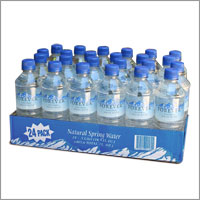
So, how on earth can we store this much water?  The minimum is 1,820 gallons for a year for my family.  We live in a little town house, so storing it inside is not something that can be done.  We decided to start small.  We first started with 72 hours of water storage for our family.  A case of 8 oz bottled waters (24 bottles) is a 72 hour storage for one person.  That's easy enough.  Cases of water are cheap.  I've seen them for as little as $2.50 each.  You can even be a little picky with brand at that price. 

Next we have worked on a two week's storage.  That's 14 gallons per person.  You can buy gallons of water at the store for as little as 78 cents each.  You might even be able to find them as little as 50 cents each.  Or, even better...  You know all of those 2 liter soda bottles and juice bottles that you throw into the garbage when you are done with them?  They are perfect for water storage!  You don't want to use just any plastic bottle.  You want ones that are food grade quality.  They will say PET(E) on them somewhere.  Do not use milk jugs or any that look like milk jugs.  THEY LEAK!  The plastic breaks down and it is a mess.  I speak from experience on this matter.  We bought water in 5 gallon jugs from the grocery store and went into our closet where we had them stored one day only to find soggy carpet and a huge mess!
For our family, this only goes so far.  It is hard to find the space to store all of these water bottles.  So we've begun looking into some other options for water storage.  Here is what we have come up with:

5 gallon water containers.  These are nice if you want to store water in the house or you want to move the water very often.  The last one is collapsible which is nice to travel with because it takes less space as you use more of the water.  


3.5 Gallon Stackable


I like the water bricks because they are stackable.  They only hold 3 ½ gallons, which makes them easy to carry and move.  They are pricey though.  I’m not sure if the convenience is worth the cost.  If you are looking for something less expensive that can be stacked, you might like the water boxes.  The bad thing about those is that you don’t want to stack them very high because the weight of the water will crush the boxes.  


My favorite water storage tank that I have found out there is the Super Tanker.  You have the choice of 125 or 250 gallons.  I like that they hold a lot of water and I like that they have 2 spouts on them including one at the bottom so you don’t have to worry about how to get water out of the bottom of the tank.  You don’t have to siphon your water out which is very nice.


Last, but not least is an option I’ve seen many people with.  That is the swimming pool!  This is probably the most fun option, but not necessarily the best option.  It really depends on where you are as to how well this will work for you.  First, they not only cost quite a bit of money and water to fill, but you do have to pay for upkeep.  Some people choose pools that have chlorine and other chemicals; some people choose pools that use salt.  Either way, you will have to purify the water before you can drink it.  With a salt pool, you will need to use a desalinator to take out the salt.  Make sure whatever purification system you have will purify as many gallons of water as you have.  You will also need a pool cover if the electricity were to go out because once the filters stop working, a beautiful green algae will grow in your pool.  A cover will help reduce this problem.  You can use a tarp if you don’t have a pool cover.  Everything I have read so far is that your pool should be used as backup storage, not primary water storage. 

Saturday, May 28, 2011

Peach Freezer Jam

The recipe made 3 pints of jam
My friend's peach tree was bursting with peaches the other day and so I took a few off of her hands.  I finally got to them today and made some yummy peach freezer jam!  You might guess that I prefer freezer jam.  I think it just tastes fresher and holds the true flavor better.  I know how to do other jams.  I just like the taste of freezer jam better.  It is so easy to make too.  The last time I worked with peaches I blanched them.  The problem with this is that it makes them soggy and they fall apart and lose their shape.  I just didn't like that.  So this time I just washed and peeled them.  I used a peeler on the ones that the skin didn't just peel off easily with my fingers.  It worked beautifully.  I then chopped them up really small and added them to a big bowl of sugar.  I followed the direction in the Sure-Jell box.  I stirred them together, let them sit for 10 minutes and then made the pectin to add to it.  That's just pectin and water.  I then poured the pectin and water in and stirred and stirred.  When it looked like it wasn't grainy anymore, I stopped stirring and spooned it into jars.  I have one of those canning funnels that made it much easier.  And now I have peach jam!  Yep.  It's that easy!  My
picture shows the peaches I peeled, but didn't need.  See how good
they peeled with the peeler? 

Buzz off!

"Long" and scraggly hair on my son.

 I wish I had a better picture to illustrate how scraggly my son's hair was looking.  This is the best I could find.  But it was from a couple of weeks ago.  We were actually having to make him brush it. In our family, we like SHORT hair on our boys.  And this picture is not considered short in our book.  We like it buzzed off!  So, for such an easy cut, we have the choice of taking them somewhere and paying $10-$20 to get it done OR buying a simple hair cutting kit for about $15 and doing it ourselves. 


Simple, but adequate hair cutting kit
 You might guess that we opted for the hair cutting kit.  My husband cuts his hair with the #1 comb and we cut my son's hair with the #3 comb.  It takes maybe 10 minutes and is extremely easy.  My son has probably 4 or 5 cowlicks, so that makes a little harder, but once we figured out to just come at it in several different directions, that made it much easier.  We make it a little shorter around the ears and use no comb on the back to straighten everything out. 


Dad doing the finishing touches

Using the vacuum
Another trick we learned was using the
vacuum while we cut.  Our son hates the hair all over him and we went to a barber a long time ago that had the shaver attached to a vacuum.  Remember the Flowbee? Instead of going out and buying a Flowbee (which we couldn't find for a long time), we just bring out the vacuum.  Either he holds it or one of us holds it while the other one cuts.  This makes for much less cleanup when the job is done too. 


Handsome and ready for the summer!

As for the girls in our family, we still go every couple of months to get our hair cut.  We do our own trimming of the bangs and when it is long enough, I trim the back of my daughter's hair.  On my list of things to learn is how to do "girlie" short hair cuts.  Until then, we at least save money on the boys' cuts!


Gone to seed!

We have been gardening for a few years and one of the new things we are learning this year is how to collect our own seeds.  I thought this would be much harder than it has been. 


Dried okra pod and seeds
Last year, my daughter collected seeds from the dried out pods on my mom's okra bushes.  She loved that when you shook the pods they rattled and was even more excited when she brokethem open and found seeds.  We pulled out the seeds
Our new okra plants
and planted them
wondering if they would
really grow.  We've heard a lot about buying only heirloom seeds because the others would not produce seeds to grow new plants.  Well...  the verdict is in!  They grew!  Hooray!  We are going to have to thin them out, so many grew! 


Flowering lettuce plant with puffs
Separating seeds from other plant matter
We have also been saving seeds off of our lettuce.  Did you know lettuce flowers?  I didn't.  But it does.  It flowers and then it puffs!  Kind of like dandelions.  It also has a milky white, sticky substance that comes off of it when you touch it to take the puffs off.  We've also found that the flowers blossom in the morning.  We usually go out in the afternoon and look at our garden, but this morning we decided to go out in the morning.  We were greeted with hundreds of little yellow flowers.  To collect the seeds, you just cut off the puffs.  Then you squeeze it and little black seeds come out.  We were most successful separating the seeds and the other plant parts on a piece of paper.  It took a little while, but it is exciting to think about planting them next season.


Oh, this is spinach!
We were next going to collect spinach seeds.  We thought the other bush with similar yellow flowers was spinach.  WE WERE WRONG!  Can't help but laugh at myself about that.  I just thought they were similar plants and another plant that was growing was a different kind of lettuce.  Well, as we looked up how to harvest spinach seeds, we realized that the other plant was the spinach.  It looks totally different.  We also have to wait for it to die before harvesting the seeds.  So I will share more about that when the time comes.


Next year we will plant more
Carrot flowers take 2 years to grow and seed
One more seed we learned about were carrot seeds.   Carrot seeds take 2 years to grow.  Yes, you have to leave the plant in for two years before being able to get seeds from it.  Carrots grow flowers too.  We also learned
that the tops of the carrots should poke out of the soil when they are ready to pick.  We picked anyway and got smaller carrots, but they tasted good.  The ones that did look big enough got
eaten by roly polies (pill bugs).  We were sad.
Picking carrots
Roly polies ate our best ones!


Sunday, May 15, 2011

Hindsight is 20/20...

Mile wide tornado that traveled through the middle of Alabama.


Rental house we considered.
A few weeks ago, tornadoes ripped through the south destroying thousands of homes and taking hundreds of lives.  An F4 tornado went right through the town in Alabama we lived in just seven months ago.  We had felt good about our decision to move back home to Nevada before, but now are extremely grateful.  The home we lived in and our old neighborhood still stands.  But we had spent months and months looking for a new place to live before we left with absolutely nothing feeling right.  We now know at least one of the houses we considered is completely gone.


Grocery store with no roof.
The other night, I got a phone call from one of our neighbors.  She told me about the devastation in the area.  She told me exactly where the tornado had hit.  Many, many houses in that town are completely gone.  The only grocery store there is shut down for at least 8 weeks waiting for a new roof.  The bank is open only a few hours a day because of utility problems.  For 2 weeks they had to drive to the next large town to pick up their mail.  Large trucks are everywhere cleaning up the mess.  You have to show your ID and prove you live in the area to be allowed to enter.  Or you must have a special pass given to those who are coming to help clean up.  And this is just one of the many towns in the south that has been hit.


Downed power and phone lines everywhere.
My first reaction to this tragedy was sadness and shock.  I worried about my friends.  I made phone calls to those I was closest to.  I watched on Facebook to hear reports of others.  The neighbor I heard from this week was the only one I was unable to reach as I did not have a cell phone number for her.  Their phone lines are still down which means her DSL internet is not working either.  We worried the first few days that they were hit, but fortunately friends who had been able to go back in the area let us know that the part of the street we had lived on had been missed.  About 10 houses or so down the street was completely gone.


CERT Team helping out at a friend's house.
As I felt sadness for all of those who had lost family members, friends, and their homes, I couldn't help but feel gratitude for our family's safety.  At the same time, I wanted to be there to help.  It was such a split feeling inside of me.  Recently my husband and I went to CERT training.  It helped prepare us to deal with such tragedy and trained us to do search and rescue and to be first responders.  It was a free course and worth every minute we spent taking it.  It would have been very useful to have the information in this kind of situation in an area that that took a long time for rescue teams to get into.  There was a story about this here.  Basic training in first aid and search and rescue not only prepares you to help your own family, but
also prepares you to help anyone in a tragedy.


Downed power and phone lines.
As I mentioned before, not everyone lost their house.  I'm not sure how you could prepare for losing your house other than having a bug out kit with 72 hours of basic supplies in it that you keep with you at all times.  But what about for those whose houses were still standing?  How did this tragedy affect them?  First, they had no power almost immediately.  Power lines were down everywhere.  I know several of our neighbors already had generators as losing electricity happened often in that area.  To be prepared, having gas to run these generators would be very important.  A few organizations brought in generators to help people out.  But as you know, generators can only do so much and only last for so long.


Causes of Power Outages
What do you do to preserve the food in your fridge and freezer(s)?  If the appliance thermometer stored in the freezer reads 40F or below, the food is safe and may be refrozen. If a thermometer has not been kept in the freezer, check each package of food to determine the safety. Remember you can’t rely on appearance or odor. If the food still contains ice crystals or is 40F or below, it is safe to refreeze. Refrigerated food should be safe as long as power is out no more than 4 hours. Keep the door closed as much as possible.  According to the USDA Food Safety Inspection Service food in your fridge will stay cold up to 4 hours.  Food in your freezer will stay cold up to 48 hours.  When electricity comes back on, you will determine the temperature of your 
food.  If it is more than 40 degrees F, then you 
need to throw it out.  Worst case, remember the 
old adage: "When in doubt, throw it out."  This  
link is to a pdf with more information about what 
to do in case of a power outage.


Charcoal Grill


Fire pits are handy!
Your freezer/fridge should not the only thing you should be worried about.  Electricity is not the only thing either.  As I talked to my friend, I learned that after the tornado passed, they had lost electricity and phone, but still had gas.  Unfortunately, because so many houses had been destroyed, there were gas leaks everywhere.  So the gas was completely shut off.  Without gas, you have lost your source for heat and cooking inside your house.  If it is cold out, it is important you have another source for heating your home with proper ventilation.  If it is hot out, open up your windows and go outside.  Your house needs ventilation running through it.  The newer your house is, the more important this is as with all of the "energy efficient" improvements, your house will not "breathe" and can cause unforeseen problems, even death from lack of oxygen.  You can cook on a grill outside or build a fire pit.  If you have never cooked over an open fire, it would be a good idea to learn before a disaster occurs and practice often.  It is fun and tasty to grill outdoors.  You will probably also use your outdoor cooking to boil water for safe drinking.


Boiling water on a grill.
A boil alert had been sent out to many areas of Alabama.  I read on a Facebook post about how silly that was if you had no way to boil water.  However, there are ways.  Remember the grill and firepit I mentioned above? According to the Wilderness Medical Society, water temperatures above 160° F kill all pathogens within 30 minutes and above 185° F within a few minutes. So in the time it takes for the water to reach the boiling point, all pathogens will be killed, even at high altitude.To be extra safe, let the water boil rapidly for one minute, especially at higher altitudes since water boils at a lower temperature.


3 days drinking water storage for one person.
If you are lucky enough to have water still coming to your home, there is a good chance that it will have all kinds of unsafe particles in it.  It will be important to purify the water before drinking it.  Having two weeks of water on hand is the minimum suggested for those trying to prepare for emergencies.  Many people find that safe drinking water is hard to come by in a disaster, even if the disaster is a flood.  Know how to purify water ahead of time and be prepared with any supplies you may need.  I'll add a blog just about this at a later time.  Also, you may want to bathe before you have electricity and gas again.  I thought my friend was
smart because she filled up plastic trash bags with
water outside and left them sitting in the sun to warm.
Then they had warm water to bathe in.  Just make sure
that you have bags that are not pesticide treated.


Cell phone tower hit by a tornado.

I learned that my neighbor's phone was still out and even their cell phones had been unusable at first.  For a phone outage, cell phones tend to be very handy.  However, even cell phone towers go down.  If you can let family members know you are okay, that is good.  Otherwise, just focus on taking care of your family and neighbors until you can.  Do your best not to leave them hanging.  Friends and family will worry about you.  But remember, this is not your first priority.  Your first priority is to make sure you and everyone around you are okay.


PG Elementary
I told my neighbor how worried we had been about her and her family.  My children were good friends with her grandson and were sick with worry.  She assured us that they were all physically fine, but emotionally were struggling.  They visited the devastation on other streets and were shocked at the destruction.  Where forest used to be, there are just some broken trees.  There was a car up in a tree.  Debris was still everywhere even with as much as had been picked up already.  She talked about how great the schools had been, opening their doors quickly to the children and providing counselors to help them through this ordeal.  Instead of pushing academics on the children, they played games with them and did art and other 
fun activities.  At first, I was shocked that they 
could open back up so quickly again, but as I t
hought about it, I realized they were attempting to 
bring back some semblance of normalcy to these 
children.  Many had been displaced and many were 
suffering loss that will take a long time for them 
to feel peace and safety again.  Opening up the 
schools to these children was a good thing.  It also 
gave parents the time they needed to begin sifting 
through the remains of their homes or help their 
neighbors.  


The thing my neighbor was most thankful for was God.  She was grateful how He had protected her family in so many ways.  Her daughter's workplace was completely gone except for her desk which a coworker hid under as the tornado passed through.  She happened to be gone that day helping her father with doctor appointments.  Her grandson had been sent home early from school because of a power outage.   Their house had been missed completely.  Neighbors were seen out of their houses everywhere helping each other and talking to each other.  Churches were serving meals throughout the day and providing clothes and other items that people lost.  One of the churches even had showers for those who were unable to shower in their homes.  Families opened their doors to displaced family members.  And considering the severity and number of tornadoes that passed through Alabama that day, very few lost their lives.  Sometimes it takes a tragedy and loss of things like power to get us out of our houses and helping others.  It helps us to count our blessings and to be grateful for all that we have.  Some were angry with God, but most people there were just grateful for the goodness of God.  They were grateful for the knowledge they had been prepared with and for the help that came in to bless them in their time of need.  It was amazing talking to her and hearing her sweet testimony of the goodness of God.

As I have talked to each of my friends and have read their posts on Facebook, I have seen their good hearts and their willingness to help wherever is needed.  They have opened up their homes to friends and family.  They have spent countless hours helping with cleanup, preparing food, and delivering donations of items.  They are amazing people in Alabama.  They have good and giving hearts and are people that I am so grateful to God that He allowed me to know them even though it was for a short period of time.  I wish I could be there working side by side with them.  But for now, I hope that my blog will help someone out there start their journey of preparing their ark for any tragedies they may encounter in their future or perhaps just work to make their present just a little bit better by bringing safety and peace into their lives by being prepared for anything that might come along.